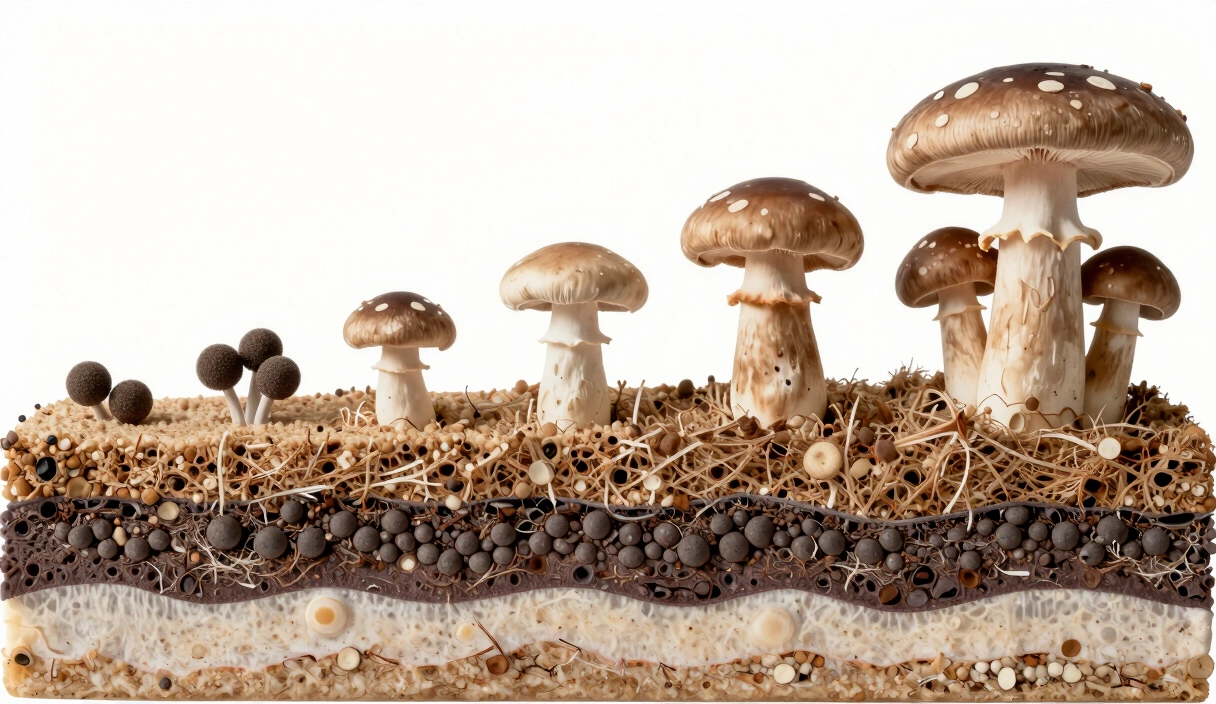
The Biology of Fungi: From Spore to Biological Efficiency
From spore germination to fruiting body — the complete biology of how mushrooms grow. Enzymatic lignin breakdown, BE calculations, and fruiting triggers.
Contents
Around 600 AD, farmers in China’s Zhejiang province noticed something their neighbors had missed for centuries. Wood Ear mushrooms appeared reliably on certain fallen logs after the monsoon rains—but only on specific tree species, only in shaded ravines, and only after the wood had aged for a particular window of time. They were not just foraging. They were reverse-engineering how mushrooms grow by observing the conditions that triggered fruiting. Fourteen centuries later, we have identified the enzymes, mapped the metabolic pathways, and quantified the gas ratios. The fundamental question has not changed.
The fungal organism is not a plant. It is a heterotrophic recycler that extracts energy from carbon-rich substrates through external digestion—secreting enzymes onto wood and absorbing the released sugars through its hyphal network. Understanding the biology of how mushrooms grow requires managing the Respiratory Quotient (RQ), optimizing enzymatic activities, and reading the visual signals that tell you whether your organism is thriving or stalling.
The Enzymatic Engine: How Fungi Eat
Mushrooms are the master decomposers of our planet. They utilize a specialized toolkit of Lignocellulolytic Enzymes to break down the most resilient organic polymers on Earth: Lignin and Cellulose.
White Rot vs. Brown Rot Strategy
Most gourmet mushrooms (like Oyster and Lion’s Mane) are White Rot Fungi. They possess an elite suite of oxidative enzymes, including Laccases and Lignin Peroxidases.
- The Mechanism: Unlike bacteria, which must ingest small molecules, fungi secrete enzymes onto the substrate. These enzymes act like biological “scisssors,” breaking down the large, complex chains of wood into simple sugars that the hyphae can then absorb.
- The Technical Rationale: This is why substrate selection is critical. If you provide a substrate without enough accessible cellulose or the correct nitrogen balance, the fungus will expend more energy producing enzymes than it gains in nutrients, leading to stalled growth.
The Secret Metric: Biological Efficiency (BE)
In commercial mycology, weight is money. But how do you measure if your grow was actually “successful”? We use the Biological Efficiency (BE) formula. This metric was developed by the mushroom industry to standardize yield comparisons across different substrate types.
The BE Formula
$$BE = \left( \frac{\text{Weight of Fresh Mushrooms}}{\text{Weight of Dry Substrate}} \right) \times 100$$
- 100% BE: This is the gold standard. If you start with 1kg of dry substrate and harvest 1kg of fresh mushrooms, you have achieved 100% efficiency.
- Commercial Targets: Professional growers often reach 150% to 200% BE over multiple flushes.
- Why it matters: Understanding BE allows you to compare the performance of different genetics and substrate recipes (like CVG vs. Masters Mix) scientifically.
Mycelial Morphology: Reading the Growth
As the mycelium colonizes your grain or bulk substrate, its visual pattern (morphology) tells a story about its health and genetic potential.
1. Rhizomorphic Mycelium (The Alpha)
Appears as thick, rope-like strands. This morphology is highly organized and optimized for long-distance nutrient transport and rapid expansion.
- The Signal: Rhizomorphic growth is a sign of strong, aggressive genetics. It is the preferred state for high-yield isolation on agar. Open a jar with strong rhizomorphic growth sometime and just look at it under a desk lamp—those thick white cords branching across the grain look like a river delta photographed from orbit.
2. Tomentose Mycelium (The Fluff)
Appears as soft, cotton-like fuzz. While not necessarily “bad,” tomentose growth is less organized and can sometimes indicate weak genetics or an environment with excess nutrients where the fungus doesn’t need to “search” for food.
The Marker of Health: Look for “reaching” hyphae. If the mycelium is climbing the glass of your jar or the walls of your tub, your CO2/O2 exchange is likely optimized for vegetative expansion.
Foundational Tools for Mycology
Mushroom Agar According to Kimmig (Pack of 20)
Pre-poured sterile agar plates optimized for fungal mycelium growth.
Check Price on Amazon
Lion's Mane Mushroom Liquid Culture Making Kit
Professional kit for expanding and storing mushroom liquid cultures.
Check Price on Amazon
Superior Dung-Loving Mushroom Substrate & Milo Grain 6lb All-in-One Bag
Pre-sterilized all-in-one grow bag with coir, vermiculite, and gypsum formula.
Check Price on Amazon* Affiliate links. Prices last updated March 6, 2026.
Metabolic Triggers: The Physics of Pinning
The transition from vegetative growth (Stage 4) to reproductive growth (Stage 5) is the most critical moment in the cultivation cycle. This is triggered by a radical shift in the fungal Metabolism.
The CO2 Shock
During incubation, fungi can tolerate CO2 levels as high as 10,000 ppm. This high-CO2 environment protects the mycelium from many competitors. However, to fruit, that level must drop precipitously.
- The Trigger: A drop to < 800 ppm CO2 signals the fungus that it has reached the surface of the wood or soil and is safe to release its spores. Picture this: the mycelium has been growing in darkness, surrounded by its own exhaled CO2 for weeks, and then suddenly fresh air floods in—that single atmospheric shift is enough to flip the entire organism from growth mode to reproduction mode.
- The Signal Pathway: This drop in CO2, combined with surface evaporation and light, activates the cAMP (Cyclic Adenosine Monophosphate) signaling pathway, which tells the mycelium to stop producing biomass and start building Primordia (Pins).
Troubleshooting the Lifecycle
Even with perfect biology, environmental stress can stall the cycle.
| Signal | Diagnosis | Solution |
|---|---|---|
| Fuzzy Feet | CO2 > 1000 ppm at the base | Increase Fresh Air Exchange (FAE). |
| Aerial Mycelium | High Humidity / Low FAE | The fungus is “reaching” for air; increase gas exchange. |
| Metabolites (Piss) | Immune Stress | Yellow liquid indicates the fungus is fighting bacteria or heat stress. That golden puddle pooling at the base of your block is the mycelium bleeding antibiotics into its own battlefield. Check your temps! |
| Abortions | Humidity Drop | Pins turn black because RH fell below 85% during development. |
Grab a jar of colonizing grain spawn, hold it up to a light, and identify whether the growth pattern is rhizomorphic or tomentose—then read the 7 stages of the mushroom lifecycle to understand exactly which metabolic phase your organism is in right now.
Frequently Asked Questions
Do mushrooms need light to grow?
Mushrooms do not photosynthesize—they get zero energy from light. But they are phototropic, using light as a directional signal that tells the fruiting body which way is “up” for spore dispersal. A low-intensity 6500K LED on a 12/12 cycle is enough for most gourmet species. Skip the expensive grow lights; a $12 daylight bulb from the hardware store does the job.
Why does my mycelium turn yellow during colonization?
That yellow liquid is secondary metabolites—antibiotic compounds the mycelium secretes when it detects a threat. Heat stress, dehydration, or a nearby bacterial colony all trigger this immune response. A few small yellow spots are normal and mean the fungus is winning the fight. Large pools of liquid pooling at the base of your jar indicate a serious environmental problem that needs immediate attention.
How long does it take to grow mushrooms from inoculation to harvest?
Oyster mushrooms are the fastest at 3-4 weeks total. Lion’s Mane runs 5-7 weeks. Shiitake on supplemented sawdust blocks takes 8-12 weeks, or 3-6 months on traditional logs. The biggest variable is “leap-off” time—how quickly the mycelium establishes on the substrate after inoculation. Grain spawn with more inoculation points (like millet) consistently beats larger grains on speed.
What is the difference between rhizomorphic and tomentose mycelium?
Rhizomorphic mycelium forms thick, rope-like strands that look like branching roots—a sign of aggressive genetics optimized for rapid nutrient transport. Tomentose mycelium appears as soft, cotton-like fuzz that expands slowly and evenly. Both are healthy growth, but rhizomorphic morphology is what you want to isolate on agar for commercial-grade yields.
Can I reuse spent substrate blocks for another grow?
Not for the same species. After 3 flushes, the accessible nutrients are exhausted and bacterial competitors have established. But spent substrate is excellent garden compost, worm feed, or a base layer for outdoor King Stropharia beds—the residual mycelial protein feeds secondary decomposers and builds soil structure.